back

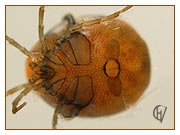
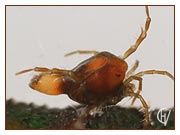
A composite photo of the palps of the female A. buccinator specimen from the previous page. The mite has died, after which dissection was performed. The ends of the palps were not sharp in this image and have been inserted from the same photo. It is clearly visible that the palps do not have dense brush groups on the inside. The photo was taken with a phase contrast microscope. A living watermite holds the palps bent downwards, the photo on the bottom right gives a bit of an impression of this.
This photo also gives a good general impression of the palps of the Arrenurus
species. Note the fine-meshed armour and the remarkably compact build. The 'claw' of
the palp is actually the fifth segment (P V). The fourth segment
(P IV) has a recess into which P V can
be folded. In this way, a kind of grasping pincer is formed. Why the palp has this
particular shape I do not know. Ostracods are prey animals for Arrenurus:
perhaps the mites can clamp the feelers of these ostracods well with their palps. Uchida
(1932) saw in any case that Arrenurus mites grabbed the ostracods by the protruding antennae
with their palps. Then they also used the front three pairs of legs to hold the ostracods
firmly, until they opened their shells, which sometimes took quite a while.
The palp on the right of the photo appears to be occupied by a colony of infusoria near the
'scissor'.
Below on the left picture, the end of P IV can be seen, there seems to be a kind of transverse notch in the cavity where (the blurred image) P V fits in. Perhaps an antenna or leg of a mussel shrimp fits in there? In the right photo five or six long bristles can clearly be seen on P II. Click on the photo for a full-page version.


 Palps of A. buccinator