Where do the animals live in the ditch? - the surface


INTRODUCTION THE SURFACE THE WATERPLANTS THE SOIL
THE SURFACE: two-sided mirror.
The water surface is an important and special habitat of ditch and pond. On summer days it lies still like a dusty mirror. The reflected clouds are often more beautiful to see in it, than in the blinding sky itself. The disadvantage is that everything under water is almost invisible. A boundary between two worlds, this mirror - with special physical properties. The surface forms an invisible membrane with a certain firmness:
SURFACE TENSION. This force is created because all water molecules in water experience an equal attraction in all directions, but at the interface between water and air this force is absent on the air side. The water molecules in the top layer therefore resist a horizontal displacement. That is why a needle, which normally sinks, floats when it is carefully placed on this surface. Enormous groups of springtails glide, blown along by a gust of wind, seemingly effortlessly over the smooth mirror. Larger creatures, such as people and frogs, do not notice this force when they jump into the water. But small insects encounter a completely different water surface, so to speak! For the smallest ones it is a tough, viscous layer that they cannot penetrate, but often cannot get away from either: a butterfly that has fallen onto the water is usually irretrievably lost.
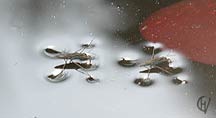
Precisely because of the high number of victims, the food supply in this eternal disaster area is large. And so a number of species have managed to make a virtue of necessity: their habitat is the dangerous surface membrane. The adaptations of these species usually consist of water-repellent parts on the body and legs, which are formed by greased hairs or a special microscopic structure. The best-known example is the pond skater, which glides over the surface as if it were an ice plain. Aided by a special microstructure on its feet, this insect walks on the water and does not sink through the membrane, but only presses small dents in it, like a trampoline jumper in the sail; in fact, it can even jump on it as if on a trampoline. If a small fly falls on the water, pond skater are quick to tap into the morsel and suck it dry. Also whirligig beetles, which lie half in and half on the water, live on fallen insects. The needle-thin waterstrider moves cautiously over the water every now and then to also pick up a piece. The boatman also benefits - but now we come to another aspect of the water surface:
THE UNDERSIDE of the water surface is the place where many aquatic animals regularly stay for shorter or longer periods. Because almost all animal species, including those under water, need oxygen, and if the oxygen in the water is not enough for them, it has to be taken from the air, and so they have to rise to the surface. Fish also sometimes gasp at the oxygen-rich top layer when there is too little in the water (warm days and/or polluted water). Salamanders dive up and take a gulp of air, after which they immediately dive away again. However, most animals in the ditch have special devices to take in air. Some water snails and many insects are lighter than water due to their air supply. They rise to the water surface and "hang" around for a while to breathe in air, for example water beetles and backswimmers. Some insects keep hanging there almost continuously and have special appendages and breathing tubes for this, for example mosquito larvae, which are important food for fish and backswimmers. So you can catch all these animals with a quick stroke, but... they usually shoot down as fast as lightning when they see the net coming! The backswimmer finds not only air but also food on the surface, for example insects that have fallen on the water. Water stick-insects and salamanders can also catch flies that have fallen on the water. The water beetle Spercheus emarginatus and its larva sieves food particles from the water surface.
Finally, there are the floating leaves of water lily, yellow water lily, pondweed, frogbit and duckweed, a habitat in itself for countless insects that live on or under it, lay eggs, make houses from pieces of leaf or simply eat the leaf. Many species live on and in the bankside plants and the mud, including those that are not considered real aquatic animals, but are bound to that moist microjungle, for example the countless forktails.
Page track: More » The location of the animals in the ditch » The surface
HOME MAIN INDEX SITEMAP FAQ LINKS CONTACT MORE
 naar Nederlandse versie
© G.H. Visser 08-08-2006 English version 07-08-2024
rev. 25-04-2026