

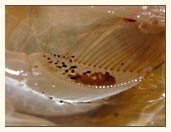
Like a mesh basket the front legs of this Lesser Water boatman, possibly Corixa punctata,
are hanging below the snout. It reminds a bit of an empty rack in front of a horse. The
front legs of most Lesser Water boatmen are flattened to form a little shovel(pala),
for the male this broadening is more obvious than for the pictured female. They shovel up
lose material from the bottom and the long sieve hairs help in raking a little heap of this
detritus to the snout, with which they than browse for eatable paricles they can suck
in. The waste of the material is thrown backwards in small clouds. Note the position of the
front legs, starting deep behind the large head and ending embracing the snout. 


ENLARGEMENT √
The snout is equipped with long hairs too, maybe be these clean the front
legs, when these brush the head... On the four pictures on the right you see the front legs
of Sigara falleni, on the two on top those of the male, on the lowest two those of
the female. The first picture is a view from below: the front legs are neatly curved in the
contoour of the head, so they can do a tight brushing. (Click on any one
of the four pictures for a page with enlarged pictures). Please notice on the top
pictures the wide pala and the line of little spines it wears: only the males have these.
With that and the fact that only the males of certain species can chirp, it was assumed that
they rubbed these spines over the ribbed snout in order to create the chirping sound. For
this reason they are called stridulatory pegs in older literature. Later it appeared
that not these pegs, but little grooves in the thigh are used for chirping.
Some species of the Lesser Water boatman have more cylindrical front legs without the
sieving hairs, for example Cymatia. These species are predators and use their front
legs to hold the prey.
 Next page: the middle legs.

back to Corixa: anatomy
Page track: INDEX » Water-bugs » Lesser Water boatman » anatomy (static version) » front legs
COPYRIGHT:
rev 11-08-2024
Nederlandstalige versie
 This page in Dutch
https://www.microcosmos.nl