HELP 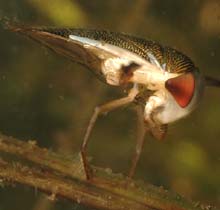
 Hover the mouse
pointer over the links on the left (general, head ...) then you should see pictures
and text changing. Keep the pointer over the part you wish to see. Clicking on a link will
bring you to a page with more information and pictures. If it doesn't work right or
you find this too cumbersome, then click on on the word HERE in the line higher on
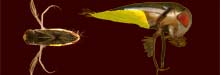
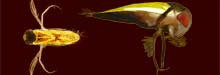
this page general Like many bugs, the lesser water boatman is somewhat flat,
though the body is highly adapted to the life it leads in the water. When the shields and
the wings are extended, the lesser boatmans body resembles that of a tiny fly. When
submerged it looks more powerful by the surrounding bubble, which also streamlines the
total profile.
Hover the mouse
pointer over the links on the left (general, head ...) then you should see pictures
and text changing. Keep the pointer over the part you wish to see. Clicking on a link will
bring you to a page with more information and pictures. If it doesn't work right or
you find this too cumbersome, then click on on the word HERE in the line higher on
this page general Like many bugs, the lesser water boatman is somewhat flat,
though the body is highly adapted to the life it leads in the water. When the shields and
the wings are extended, the lesser boatmans body resembles that of a tiny fly. When
submerged it looks more powerful by the surrounding bubble, which also streamlines the
total profile.
head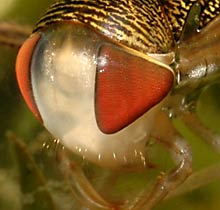
 The head is relatively large
with large compound eyes and sits as a streamlining helmet in front of the body. The head
ends downward in the short, ribbed snout. Some species have a groove, or hairs on the
front, or the face (frons) as you might say. The short antennae are hidden behind
the eyes. The neck is thin and protected by the shield which is attached behind the
head.
The head is relatively large
with large compound eyes and sits as a streamlining helmet in front of the body. The head
ends downward in the short, ribbed snout. Some species have a groove, or hairs on the
front, or the face (frons) as you might say. The short antennae are hidden behind
the eyes. The neck is thin and protected by the shield which is attached behind the
head.
thorax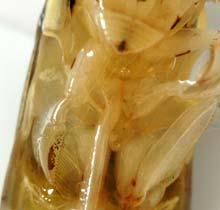
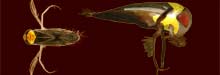 In the
(thorax) are breath openings (stigmata), in some species a pair may be
transformed in a hearing organ. To each of the three segments of the chest is pair of legs
attached. The three pairs are totally different.
In the
(thorax) are breath openings (stigmata), in some species a pair may be
transformed in a hearing organ. To each of the three segments of the chest is pair of legs
attached. The three pairs are totally different.
front legs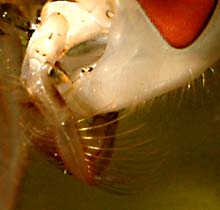
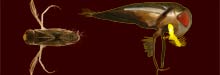 The front legs are short, the foot (tarsus) is broadened and equipped with
long hairs. With its front legs the lesser water boatman whirls up the garbage layer
(detritus) on the bottom, while the hairs sieve the material out, which is then
brought to the snout in search of nourishment. On the thigh (femur) of each front
leg the males of some species have short thorns, which where erroneously thought to be
used for making sound (stridulation).
The front legs are short, the foot (tarsus) is broadened and equipped with
long hairs. With its front legs the lesser water boatman whirls up the garbage layer
(detritus) on the bottom, while the hairs sieve the material out, which is then
brought to the snout in search of nourishment. On the thigh (femur) of each front
leg the males of some species have short thorns, which where erroneously thought to be
used for making sound (stridulation).
mid legs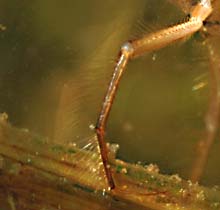
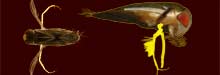 The legs of the
second pair, are relatively long and sparely haired and end in strong claws, with which
the insect attaches itself to its resting place.
The legs of the
second pair, are relatively long and sparely haired and end in strong claws, with which
the insect attaches itself to its resting place.
hind legs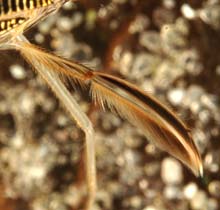
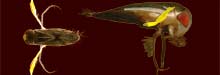 The third pair of
legs provides the propulsion: the end part is broadened en flattened and equipped with two
seams of long hairs, which flap out with the back stroke, providing a wide surface and
flap in at the front stroke, thus giving much less resistance and braking as little speed
as possible.
The third pair of
legs provides the propulsion: the end part is broadened en flattened and equipped with two
seams of long hairs, which flap out with the back stroke, providing a wide surface and
flap in at the front stroke, thus giving much less resistance and braking as little speed
as possible.
abdomen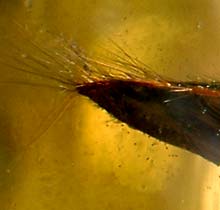
 The body (abdomen)is flat and relatively small. At
the endpoint are long hairs protruding, possibly acting as a kind of "kite tail"
for balance, and probably having a function to help the insect piercing the surface film
while taking air. front wings
The body (abdomen)is flat and relatively small. At
the endpoint are long hairs protruding, possibly acting as a kind of "kite tail"
for balance, and probably having a function to help the insect piercing the surface film
while taking air. front wings 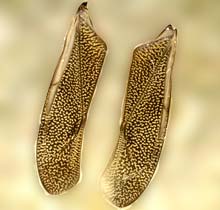
 The coloured front wings are a bug's hemelytra
which means half hardened, but we don't find a clear membranous part here, see the
picture. The front wings are used as cover and under these the second pair, of real
membranous wings are kept folded up. The second pair of wings is used for flying. Between the
two wing pairs there is a thin layer of air.
The coloured front wings are a bug's hemelytra
which means half hardened, but we don't find a clear membranous part here, see the
picture. The front wings are used as cover and under these the second pair, of real
membranous wings are kept folded up. The second pair of wings is used for flying. Between the
two wing pairs there is a thin layer of air.
Hover the mouse
pointer over the links on the left (general, head ...) then you should see pictures
and text changing. Keep the pointer over the part you wish to see. Clicking on a link will
bring you to a page with more information and pictures. If it doesn't work right or
you find this too cumbersome, then click on on the word HERE in the line higher on
this page general Like many bugs, the lesser water boatman is somewhat flat,
though the body is highly adapted to the life it leads in the water. When the shields and
the wings are extended, the lesser boatmans body resembles that of a tiny fly. When
submerged it looks more powerful by the surrounding bubble, which also streamlines the
total profile.
head
The head is relatively large
with large compound eyes and sits as a streamlining helmet in front of the body. The head
ends downward in the short, ribbed snout. Some species have a groove, or hairs on the
front, or the face (frons) as you might say. The short antennae are hidden behind
the eyes. The neck is thin and protected by the shield which is attached behind the
head.
thorax
In the
(thorax) are breath openings (stigmata), in some species a pair may be
transformed in a hearing organ. To each of the three segments of the chest is pair of legs
attached. The three pairs are totally different.
front legs
The front legs are short, the foot (tarsus) is broadened and equipped with
long hairs. With its front legs the lesser water boatman whirls up the garbage layer
(detritus) on the bottom, while the hairs sieve the material out, which is then
brought to the snout in search of nourishment. On the thigh (femur) of each front
leg the males of some species have short thorns, which where erroneously thought to be
used for making sound (stridulation).
mid legs
The legs of the
second pair, are relatively long and sparely haired and end in strong claws, with which
the insect attaches itself to its resting place.
hind legs
The third pair of
legs provides the propulsion: the end part is broadened en flattened and equipped with two
seams of long hairs, which flap out with the back stroke, providing a wide surface and
flap in at the front stroke, thus giving much less resistance and braking as little speed
as possible.
abdomen
The body (abdomen)is flat and relatively small. At
the endpoint are long hairs protruding, possibly acting as a kind of "kite tail"
for balance, and probably having a function to help the insect piercing the surface film
while taking air. front wings The coloured front wings are a bug's hemelytra
which means half hardened, but we don't find a clear membranous part here, see the
picture. The front wings are used as cover and under these the second pair, of real
membranous wings are kept folded up. The second pair of wings is used for flying. Between the
two wing pairs there is a thin layer of air.
 On the next page: the life of Corixa and how
its structure relates to that.
On the next page: the life of Corixa and how
its structure relates to that.
GENERAL RECOGNISING ANATOMY LIFE SPECIES MICRONECTA NAMES

back to WATER BUGS
Page track: INDEX » Bugs » Corixa » anatomy
COPYRIGHT:
All pictures on this site have been made by G.H. Visser
(Aadorp, Holland), unless otherwise mentioned. All rights remain with him. These
photo's may not be used for other then strictly private uses. In case you want to use
them for purposes including third parties, you MUST request permission, by e-mailing the author. I encourage especially those wanting to use the
pictures for nature-expositions or other educative targets.
© G.H. Visser 03-2002
rev 09-10-2024
Nederlandstalige versie
 This page in Dutch
https://www.microcosmos.nl