back

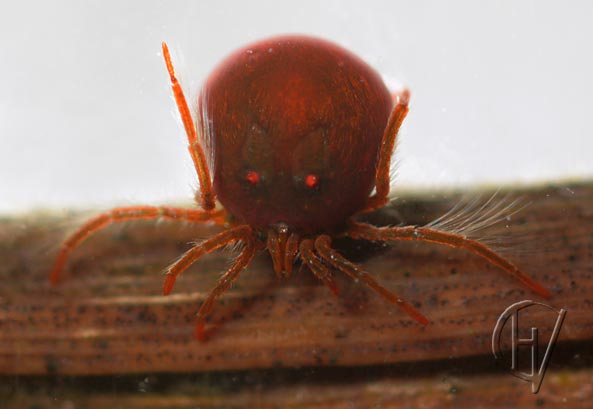
This nymph of a Hydrachna species was caught together with two similar specimens in a shallow pool in the vicinity of Zonnebeek, Boekelo (The Netherlands). They all look very much like the nymph on the previous page. It could be Hydrachna globosa: these specimens have the same plates above the eyes and the same dark red color. But also in this case, there is no certain determination.
The pool where the mites were found was so shallow, that drying out seemed inevitable. It is therefore questionable whether these mites would have survived. Perhaps the mites came along in their parasitic phase with the water boatmen, which were also in the pool. They would then simply have the bad luck to have 'stepped off' here - in the nymph phase they cannot attach themselves again to a water boatman, to fly along to better places, in case of an emergency. I therefore released the mites in the pool where the nymph from the previous page was found.
Below are a few more photos of the same specimen. Note the position of the hind legs: many water mites with swimming ability keep their hind legs in this position when they are sitting still. They then make rowing, often rowing, movements with them, close to the body. The oxygen absorption through the skin is probably promoted by the current caused by the legs.

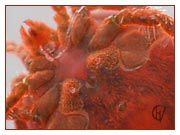
The photo below shows that they can also clean the body with their hind legs. In ditch water, everything quickly becomes covered with all kinds of microorganisms. Almost all arthropods are cleaning often for this reason, water mites probably because the growth can hinder both the swimming ability and the skin breathing. Furthermore, cleaning could distribute a protective secretion from the skin glands over the skin.